Tech Reality Check: A Microchip is NOT a GPS. A microchip only works if someone finds your dog and scans them at a vet. It cannot tell you where your dog is right now. To track a moving dog, you need a powered GPS device.
The “30-Foot” Myth that Could Cost You Your Dog
We live in the age of the “Smart Home,” so it makes sense to have a “Smart Dog.”
Apple AirTags are cheap ($29), battery-efficient, and easy to clip on a collar. Millions of owners use them.
But I wouldn’t trust one to save my dog’s life.
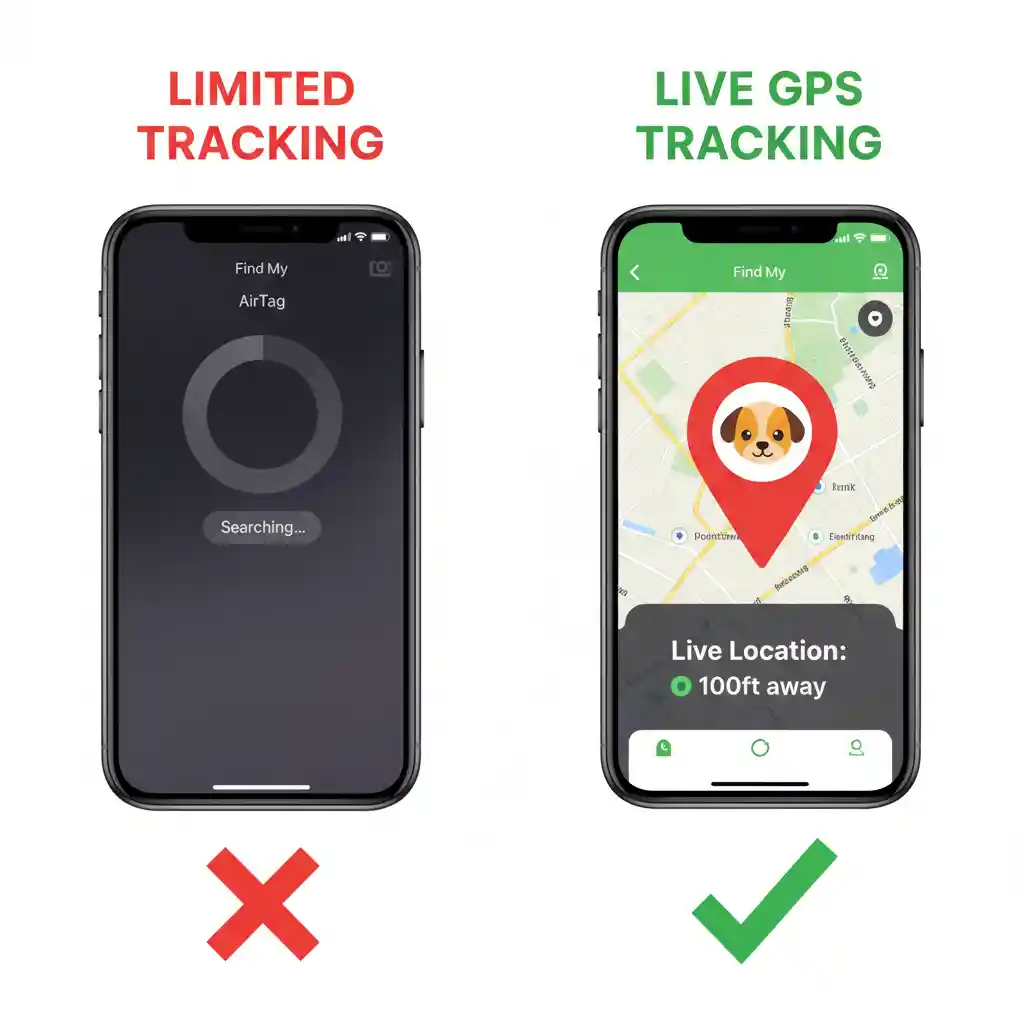
Here is the tech limitation nobody talks about: AirTags do not have GPS.
They rely on Bluetooth. They only work if your lost dog wanders within 30 feet of someone else’s iPhone.
If your dog runs into the woods, a field, or a quiet street at 3 AM? That AirTag is a brick. It will show “Last Known Location” from 2 hours ago, which is useless when your dog is running at 20 mph.
Real GPS trackers use Cellular Satellites (LTE/4G). They talk to the sky, not to passing phones.
AirTag vs. Dedicated GPS Tracker
Don’t let the price tag fool you. You get what you pay for in range.
| Feature | Apple AirTag (Bluetooth) | GPS Tracker (Cellular) |
| Range | ~30 Feet (10 Meters) | Unlimited (Anywhere with Cell Service) |
| Real-Time Tracking | ❌ No. Delayed updates based on crowd-sourcing. | ✅ Yes. Live updates every 2-5 seconds (Lost Mode). |
| Subscription Cost | Free. | $5 – $10 / Month (Cellular Plan). |
| Battery Life | 1 Year. | 1 Week to 1 Month. |
| Verdict | Good for keys. Risky for dogs. | Essential for escape artists. |
3 Features That Separate “Toys” from “Tools”
When reviewing the saturated market of smart collars, I filter out the junk using these three metrics.
1. Battery Life Under “Live Tracking”
-
The Trap: Brands claim “3 Month Battery Life!” …but that’s only on standby.
-
The Reality: You need to know how long it lasts in “Lost Mode” (pinging the satellite every second). A good tracker should survive at least 24 hours of active searching. If it dies in 2 hours, it’s useless.
2. The “Escape Alert” Speed (Geo-Fence)
-
The Feature: You draw a “Safe Zone” around your house on the app.
-
The Test: How fast does it text you when the dog crosses that line?
-
Good: Under 2 minutes.
-
Bad: 10 minutes later (your dog is already in the next zip code).
3. Durability (IP Rating)
-
The Requirement: Dogs seek mud and water.
-
The Standard: Look for IP67 or IPX7 Waterproof. It must survive being fully submerged in a pond. If it’s just “Splash Proof,” it will die the first time it rains.

Top Category Recommendations
1. The “Daily Driver” (Smart Collar)
-
Type: Integrated LTE GPS Collar.
-
Why we like it: It replaces your regular collar. It’s sleek, bomb-proof, and usually tracks steps/sleep too (like a Fitbit for dogs). The battery creates a “home base” signal with your WiFi to save power, lasting up to 3 months.
-
Best for: The suburban dog who escapes occasionally.
2. The “Clip-On” (Budget Choice)
-
Type: Universal GPS Attachment.
-
Why we like it: You don’t need to buy a whole new collar. It clips onto your existing harness. It’s cheaper upfront but requires a monthly sub. The “Live Tracking” mode is often more responsive than the fancy smart collars.
-
Best for: Hiking trips or irregular use.
3. The “Deep Woods” (No Cell Service)
-
Type: Radio Frequency (RF) Handheld Handset.
-
Why we like it: If you hike where your phone has “No Service,” a cellular GPS won’t work either. RF trackers talk directly from the collar to a handheld remote (up to 9 miles away) without satellites.
-
Best for: Hunters, Hikers, and Campers.
Frequently Asked Questions
Q: Do I really need to pay a subscription?
A: For a real GPS, yes. Think of the collar as a tiny cell phone. It needs a data plan to send the location to your phone. “No Subscription” trackers usually use Bluetooth (short range) or old radio tech (bulky handhelds), which have major limitations.
Q: Can I use a GPS tracker on a cat?
A: Size matters. Most dog trackers are too heavy and bulky for a cat’s neck. Look for specific “Mini” versions designed for felines (usually under 35 grams) to avoid neck strain.
Q: Will it work if my dog is indoors?
A: GPS signals struggle to penetrate roofs. Most apps will show the dog “Near Home Base” (WiFi) when inside. The GPS kicks in the moment they leave the WiFi range.
Manager’s Insight: The “False Security” of Fences
I hear this all the time: “I don’t need a tracker, I have a fence.”
Fences fail. Gates get left open by gardeners. Snow piles up high enough to jump over. Squirrels tempt dogs to dig under.
A tracker is not for the days things go right. It’s for the one day everything goes wrong.
I consider the $100 hardware cost + $8/month subscription the cheapest insurance policy I own. I’d pay that in a heartbeat to avoid printing “LOST DOG” posters.
Affiliate Disclosure: By clicking on the product images or links on this page, you will be redirected to Amazon. As an Amazon Associate, we earn from qualifying purchases made through these links. This comes at no extra cost to you and helps support our site’s content.