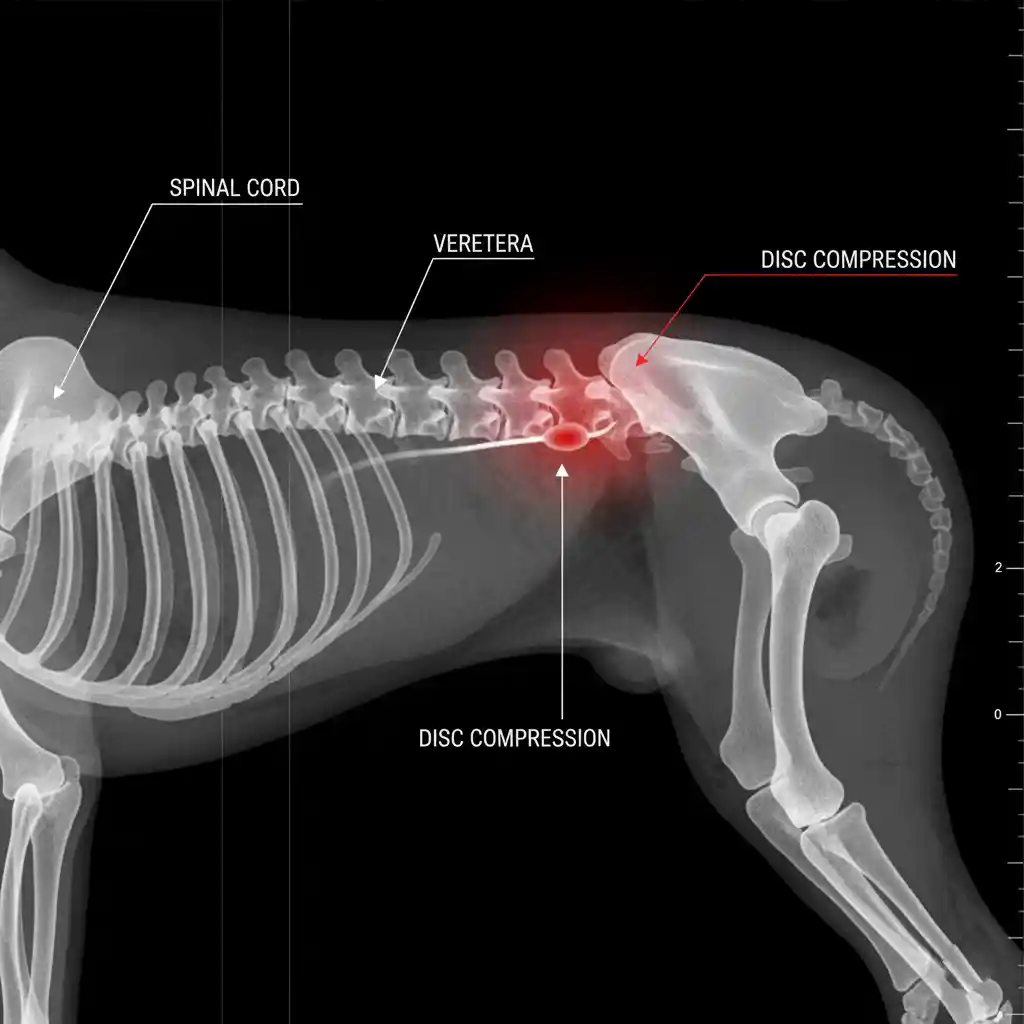
Medical Emergency Warning: IVDD can cause permanent paralysis within hours. If your dog is dragging their back legs, cannot stand, or has lost the ability to urinate, this is a medical emergency. Time is spinal cord tissue. Go to a Neurologist or Emergency Vet immediately.
The Science: The “Jelly Donut” Analogy
Intervertebral Disc Disease (IVDD) is a degenerative condition affecting the spinal cord. It is most common in chondrodystrophic breeds (dogs with short legs and long backs) like Dachshunds, French Bulldogs, and Corgis.
Think of the discs between your dog’s vertebrae like jelly donuts:
-
The Outer Layer (Fibrous Ring): The dough.
-
The Inner Layer (Nucleus Pulposus): The jelly.
In IVDD (specifically Hansen Type I), the outer layer hardens and bursts. The “jelly” shoots out upward, compressing the spinal cord. This compression blocks nerve signals from the brain to the legs, causing pain, wobbliness, or total paralysis.
Symptom Checker: Pain vs. Paralysis (Grading Scale)
Neurologists grade IVDD on a scale of 1 to 5. Recognizing Stage 1 can save you thousands of dollars and save your dog from surgery.
| Grade / Severity | Clinical Signs | Urgency Level |
| Grade 1 (Pain Only) | Arching back (kyphosis); reluctant to jump/climb stairs; shivering/trembling; head held low; crying when picked up. | High Priority. See a vet today. Strict crate rest starts NOW. |
| Grade 2 (Wobbly) | Ataxia (drunken walk); crossing back legs; knuckling over (paw drags on the ground). | Urgent. Spinal cord is compressed but still functioning. |
| Grade 3-4 (Paralysis) | Cannot stand or walk on back legs; dragging lower body; still feels deep pain (pinching toes). | EMERGENCY. Surgery is often required within 24-48 hours for recovery. |
| Grade 5 (No Deep Pain) | Total paralysis; loss of bladder control; dog does not feel a hard pinch to the toes. | CRITICAL. Prognosis for recovery drops to <50% if not operated on immediately. |
Home Care vs. Vet Care
Conservative Management (Non-Surgical):
For Grade 1 or 2 dogs, or owners who cannot afford surgery, vets often prescribe “Conservative Management.”
-
Strict Crate Rest: This means 24/7 confinement for 6 to 8 weeks. No walks, no sofa, no running. Potty breaks are on a leash only.
-
Medications: Anti-inflammatories (NSAIDs or Steroids), Muscle Relaxants, and Nerve Pain blockers (Gabapentin).
-
Goal: To allow the disc material to dry up and the scar tissue to heal over the rupture.
Surgical Intervention:
For Grade 3-5, surgery (Hemilaminectomy) is usually the only option to restore walking ability. The surgeon removes the piece of bone to relieve pressure on the spinal cord.
The Financial Reality: Surgery Costs & Insurance Traps
(Note: This section targets high-value queries regarding veterinary finance and insurance claims.)
1. The Cost of Treatment (National Average)
Neurology is one of the most expensive specialties in veterinary medicine.
-
MRI Scan (Diagnostic): $2,500 – $3,500. An X-ray cannot see discs; an MRI is mandatory for surgery.
-
IVDD Surgery (Hemilaminectomy): $4,000 – $7,000.
-
Total Bill: Expect to pay $6,000 – $10,000 per episode (including hospital stay and anesthesia).
2. Pet Insurance & The “Breed” Trap
-
Pre-existing Conditions: If your dog had “back pain” noted in their file 6 months ago, insurance will likely deny the $10,000 surgery claim today.
-
Bilateral/Spinal Exclusions: Some policies exclude spinal issues for specific breeds unless you pay extra.
-
Waiting Periods: Many policies have a 6-month orthopedic waiting period. If your Frenchie goes down in month 3, you are not covered.
-
Recommendation: Get insurance the day you bring your puppy home.
3. Supplements & Prevention
While no pill fixes a ruptured disc, preventative care focuses on reducing inflammation.
-
Omega-3 Fatty Acids (Fish Oil): High doses can support joint and nerve health.
-
Weight Management: Keeping your dog thin is the #1 way to reduce spinal strain.

Frequently Asked Questions
Q: Can a dog recover from IVDD without surgery?
A: Yes, for Grade 1 and 2 (pain/wobbly), strict crate rest has a high success rate (over 80%). However, for paralyzed dogs (Grade 4-5), recovery without surgery is statistically unlikely and often results in permanent disability.
Q: Will it happen again?
A: Sadly, yes. IVDD is a degenerative disease of all discs. About 20-40% of dogs may have a recurrence in a different part of the spine later in life. This is why insurance is vital.
Q: Can I use a wheelchair for my dog?
A: Absolutely. If surgery is not an option or fails, dogs can live happy, pain-free lives with a custom canine wheelchair (cart). They adapt surprisingly fast.
Manager’s Insight: The “Wait and See” Gamble
I have reviewed hundreds of insurance claims for IVDD. The most heartbreaking cases are the ones where the owner “waited to see if he got better” over the weekend.
Deep Pain Sensation is the countdown clock. Once a dog loses the ability to feel a pinch on their toe (Grade 5), their chance of walking again drops to 50% even with surgery. If they still have deep pain, the success rate is 90%.
If your dog’s legs look drunk, don’t wait for Monday. Go to the ER. It is better to pay for an emergency exam and be told “it’s just a sprain” than to wait and face permanent paralysis.