
BEHAVIORAL SAFETY NOTE: This guide focuses on Demand Barking (barking to get food, play, or attention). If your dog is barking at “invisible” things, snapping at the air, or if the barking is accompanied by growling/stiff body language when you approach them, this may be a medical issue or aggression. Consult a vet or behaviorist immediately.
It’s Not “Sass,” It’s a Learned Skill
Picture this: You finally sit down after a long day to watch TV. Your dog walks up to you, stares you right in the eyes, and lets out a sharp, rhythmic WOOF. You ignore it. They bark louder. WOOF! WOOF! Eventually, you look at them and say, “What do you want?” or you toss a toy just to make it stop.
Congratulations. You have just been trained.
In animal psychology, we call this Demand Barking. It is not a sign of “dominance” or your dog being a “brat.” It is simply Operant Conditioning. Your dog has learned a simple equation: Noise = Human Attention. Even if you yell “Quiet!”, that is still attention. To the dog, negative attention is better than no attention.
Diagnosis: Is It Demand or Alert Barking?
Before you start training, you must be sure you are treating the right problem. Demand barking requires a totally different approach than alert barking (barking at the doorbell).
| Feature | Demand Barking (Attention Seeking) | Alert Barking (Territorial/Fear) |
| Eye Contact | Fixed on You. The dog is staring directly at your face. | Fixed on the Trigger. Eyes are on the door, window, or fence. |
| Body Language | Bouncy, expectant, tail wagging, or “play bowing.” | Stiff, piloerection (hair standing up), ears forward or pinned back. |
| Timing | Happens when you are relaxing, eating, or on the phone. | Happens when there is a noise or visual disturbance outside. |
| The Result | Stops immediately when they get what they want (food/toy). | Continues even after you interact with them; difficult to interrupt. |
The Solution: The Art of Becoming Invisible
To stop this behavior, we must break the equation. We use a psychological principle called Extinction: removing the reinforcement (attention) until the behavior dies out.
Step 1: Identify the Trigger
What does your dog want? Is it your dinner? A walk? Or just for you to look at them? You must ensure all their biological needs (potty, water, exercise) are met before you sit down.
Step 2: Total Ignoring (The “Statue” Method)
When the barking starts:
-
No Eye Contact: Do not look at the dog. Look at the ceiling.
-
No Talk: Do not say “Quiet,” “No,” or “Stop.”
-
No Touch: Do not push them away.
-
Body Language: Turn your head or entire body away from the dog. You are effectively “disappearing.”
Step 3: Weathering the “Extinction Burst” (CRITICAL)
Here is the trap most owners fall into. When you ignore the dog, the barking will initially get worse, not better. The dog thinks, “Hey, this button usually works. Maybe I need to press it harder!”
-
They might bark louder, nudge you, or whine.
-
You must not give in here. If you give in during the burst, you train the dog to bark louder next time. Ride it out.
Step 4: Reward the Silence
The moment—and I mean the micro-second—the dog stops barking and takes a breath or lies down:
-
Mark: Say “Yes” or “Good.”
-
Reward: Calmly give them attention or a treat.
-
The Lesson: Silence is the new button that activates the human.
Frequently Asked Questions
Q: My dog nips or paws at me when I ignore the barking. What now?
A: This is an escalation. If the dog physically touches you, stand up and walk out of the room, closing the door behind you for 30 seconds. This is a “Negative Punishment” (removing yourself). It teaches the dog that physical contact results in total social isolation.
Q: Can I use a squirt bottle or a shaker can?
A: As a force-free consultant, I advise against this. Startling the dog might stop the barking temporarily, but it creates anxiety and doesn’t teach them what to do instead. It also damages your bond.
Q: How long will the “Extinction Burst” last?
A: It varies. It can last 5 minutes or 20 minutes. It depends on how long the behavior has been practiced. If you have given in to the barking for 3 years, expect a very tough week of retraining.
Q: Should I tell my dog to go to their bed?
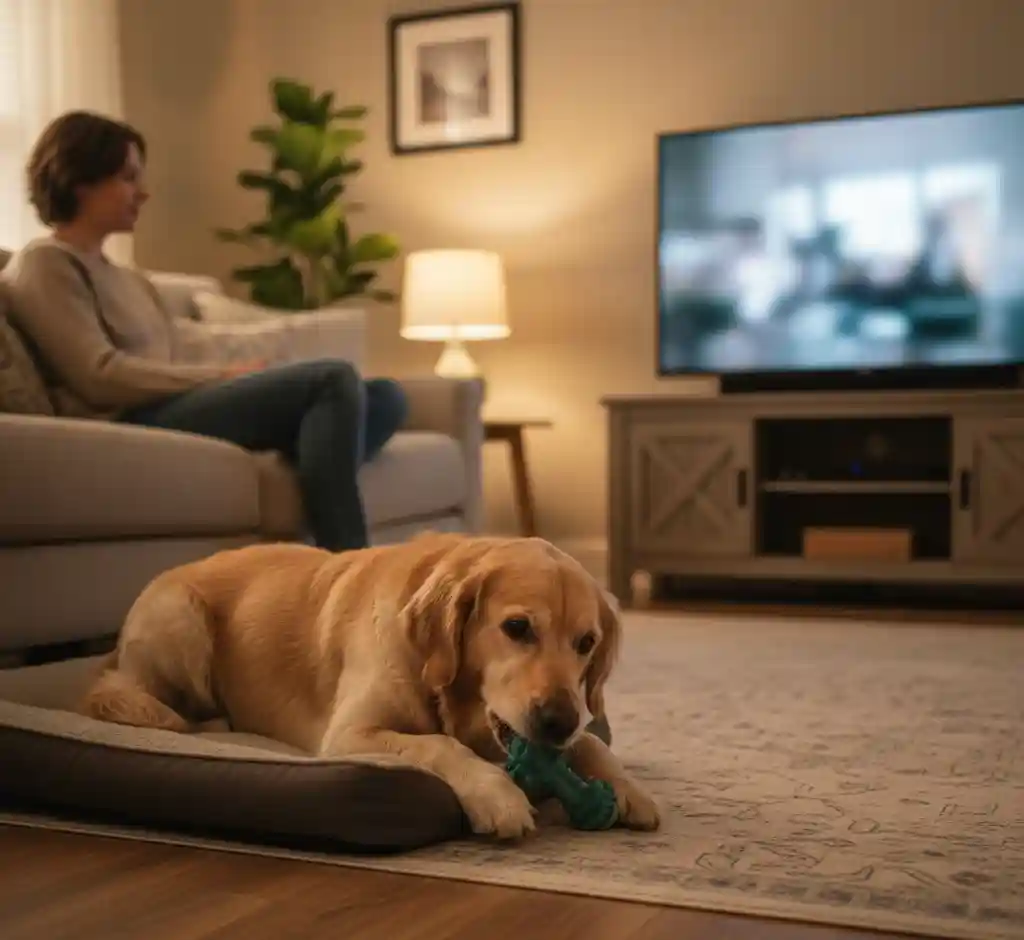
A: Yes, but only before they start barking. If you send them to bed after they bark, you are engaging in a dialogue. Pre-empt the behavior by giving them a long-lasting chew or puzzle toy on their mat before you watch TV.
Manager’s Insight: The “Spouse” Problem
Here is the “Real Talk” that usually happens in my private consults: Consistency is harder for humans than dogs.
You might be great at ignoring the barking, but if your husband, wife, or kids give the dog a treat just to “shut him up,” the training will fail. In fact, it creates “Variable Ratio Reinforcement” (like a slot machine), making the barking even more addictive.
You need to call a family meeting. Everyone must agree: The dog does not exist when he barks. If you can’t get everyone on board, buy earplugs for the family until the training sticks.
Scientific References
-
Skinner, B. F. (1938). The Behavior of Organisms. (The foundational text on Operant Conditioning and Extinction).
-
Yin, S. (2004). How to Behave So Your Dog Behaves. (Applied animal psychology for demand behaviors).
-
Overall, K. L. (2013). Manual of Clinical Behavioral Medicine for Dogs and Cats. (Protocols for deferential reinforcement).