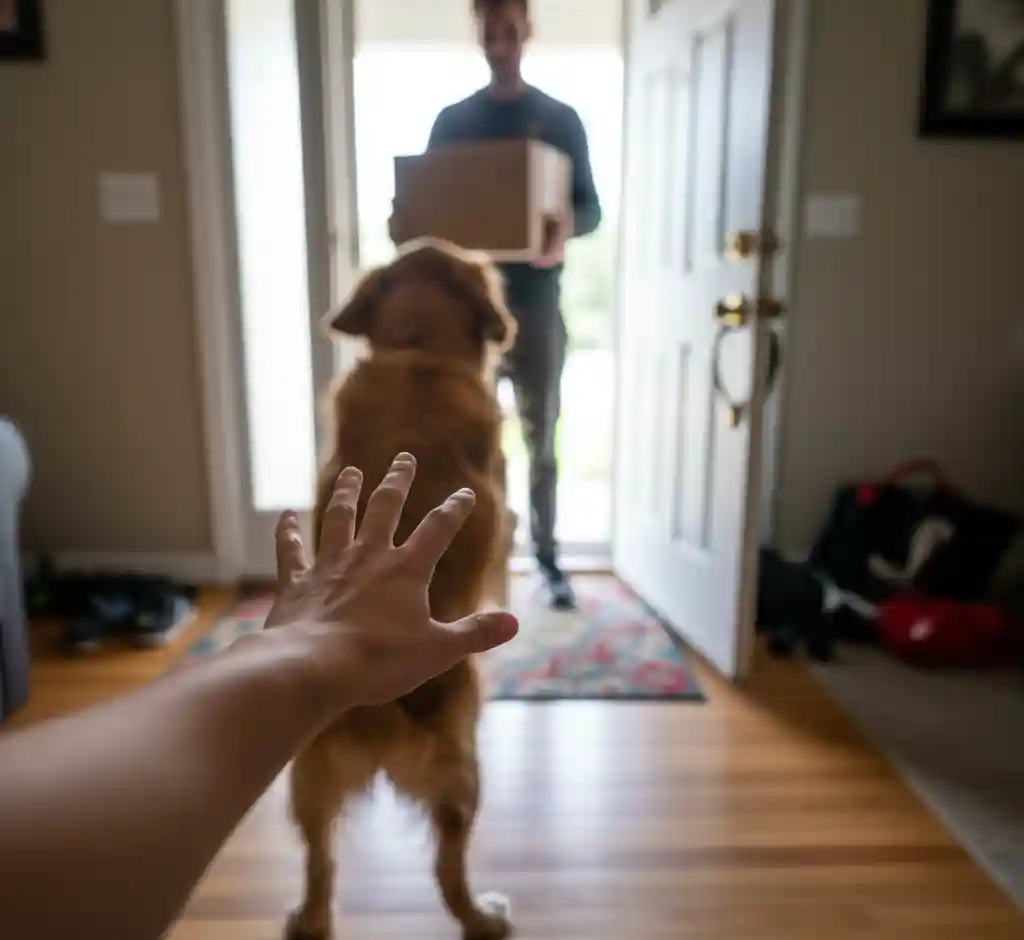
SAFETY WARNING: If your dog shows aggression at the door (stiff body, baring teeth, or attempting to bite the guest/delivery person), do not train this alone. This is a liability issue. You must manage the environment (use baby gates/crates) and contact a Certified Dog Behavior Consultant (CDBC) immediately.
It’s Not Protection, It’s a Dopamine Explosion
The doorbell rings. Chaos ensues. Your sweet dog transforms into a barking, jumping, spinning tornado. You yell, you grab their collar, you apologize to the pizza guy.
Why does this happen?
Many owners think their dog is being “territorial” or “protective.” While that can be true, for 90% of dogs, the doorbell is simply the strongest cue in the household. It predicts high-arousal events: New Humans! Smells! Action!
Over time, through Classical Conditioning, the sound of the bell itself triggers a massive spike in adrenaline and dopamine. Your dog literally cannot hear you because their brain is flooded with chemical arousal. To fix this, we don’t just stop the barking; we have to change the emotion attached to the sound.
Diagnosis: Is It Excitement or Fear?
The training protocol changes slightly depending on your dog’s emotional state. Look at their body language.
| Behavior Signal | Excitement / Frustrated Greeter | Territorial / Fearful |
| Tail Position | High, wagging fast (helicopter tail), or whole butt wiggling. | Stiff, held high and vibrating, or tucked low between legs. |
| Vocalization | High-pitched barking, whining, yipping. | Deep, guttural barking, growling. |
| Movement | Bouncing, jumping up, trying to lick or paw at the door. | Lunging, snapping, or backing away while barking. |
| Goal | “I want to get TO the person!” | “I want the person to GO AWAY!” |
The Solution: Replacing Chaos with a Job
We cannot just tell a dog “Don’t bark.” It’s too hard to stop a behavior without giving them a new one. We will teach them that Doorbell = Run to Your Bed (Place).
Step 1: Desensitize the Trigger (The Silent Bell)
-
Action: Record your doorbell sound on your phone.
-
Training: Play the sound at low volume. Immediately toss a high-value treat on the floor.
-
Repeat: Do this 10-20 times until the sound makes your dog look at the floor for a treat, not at the door.
-
Why: We are breaking the link between “Bell” and “Door.”
Step 2: Teach “Go to Place”
-
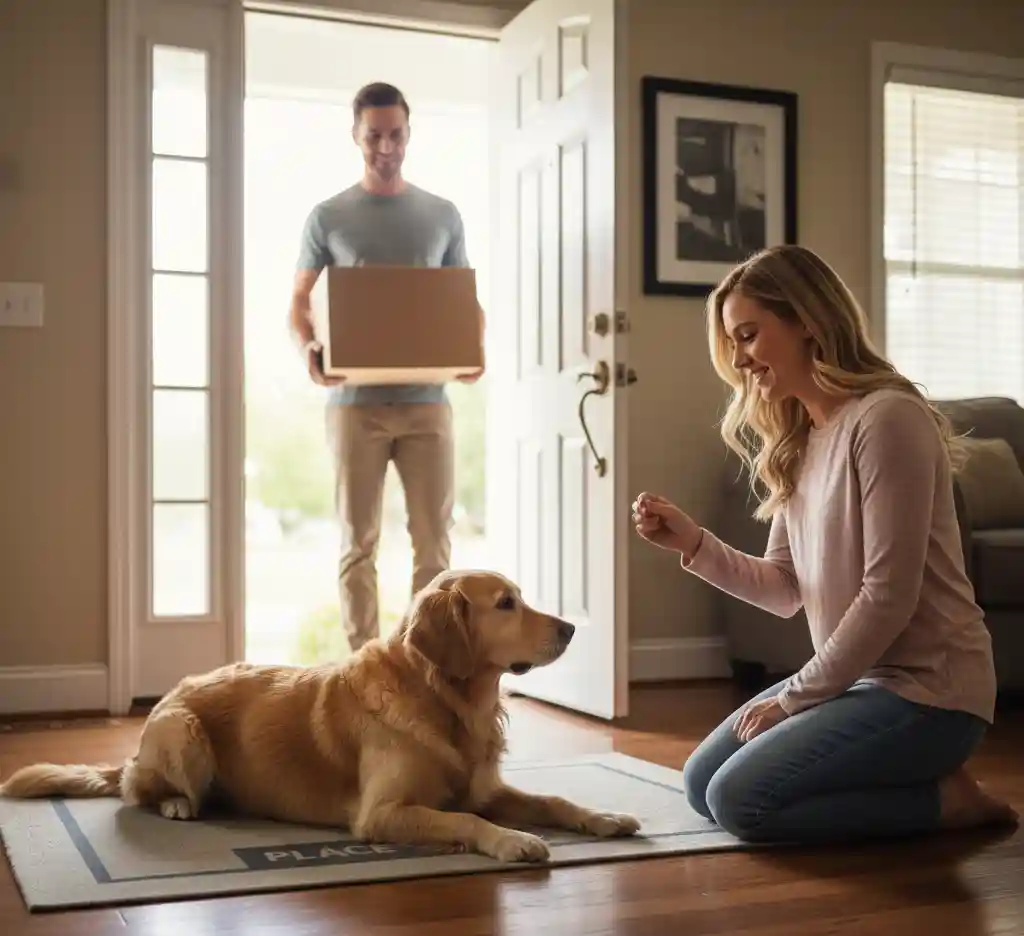
Action: Use a specific mat or bed. Lure your dog onto it with a treat.
-
Mark: When four paws are on the mat, say “Place” (or “Bed”) and reward heavily.
-
Duration: Slowly increase the time they stay on the mat before releasing them.
Step 3: Combine Bell and Place
-
Action: Play the recorded doorbell sound, then immediately give the “Place” cue.
-
Reward: When they run to the mat, give them a “jackpot” (3-4 treats).
-
Progression: Eventually, have a friend ring the real doorbell. Your dog should hesitate and look toward their bed.
Step 4: The “Airlock” Management (For Guests)
-
Action: When real guests come, keep your dog on a leash or behind a baby gate.
-
Rule: The door does not open until the dog is sitting calmly. If they bark or lunge, wait.
-
The Lesson: “Calmness opens the door. Chaos keeps it closed.”
Frequently Asked Questions
Q: Why does my dog bark at the delivery truck before they even ring the bell?
A: Dogs are excellent at “chaining” events. They hear the truck engine -> then the brakes -> then the footsteps -> then the bell. You need to desensitize the sound of the truck (Step 1) just like the bell.
Q: Should I pick my small dog up when answering the door?
A: No. Holding a reactive dog often makes them feel more bold (or trapped), leading to increased barking right in your ear. It’s better to put them behind a gate or in a crate.
Q: Can I use a bark collar?
A: I advise against it. If a dog is barking out of fear (Stranger Danger) and gets shocked when the bell rings, they will associate the pain with the guest. This can turn a noisy dog into a biting dog.
Q: What if I don’t have time to train when the pizza comes?
A: Manage it! Put the dog in a bedroom with a stuffed chew toy before you open the door. Don’t try to train in the middle of a chaotic event; you will both just get frustrated.
Manager’s Insight: The “Mailman Paradox”
Here is a secret that explains why this behavior is so hard to break: Your mailman is the best dog trainer in the world… but for the wrong team.
Think about it. Every day, the mailman comes. Your dog barks: “GO AWAY!” The mailman drops the mail and leaves.
In your dog’s mind, they just saved your life. They barked, and the intruder fled. It works 100% of the time.
This is why you can’t just ignore doorbell barking. The environment reinforces it every single day. You must give them a different job (like running to a mat), or they will keep “protecting” you from the FedEx guy forever.