SAFETY WARNING: If your dog has a history of biting that draws blood, or if you feel unsafe in your home, do NOT attempt these exercises alone. Resource guarding can escalate quickly. Please contact a Certified Dog Behavior Consultant (CDBC) or a Veterinary Behaviorist immediately for a hands-on safety assessment.
It’s Not “Dominance,” It’s Panic: Understanding the Growl
I know exactly how it feels. You pour a bowl of premium kibble for your best friend, you walk past them, and suddenly, you hear a low, guttural growl. It feels like a betrayal. You think, “I feed you, I love you, why are you threatening me?”
First, take a deep breath. Your dog is not trying to “dominate” you. They are not being “alpha.”
Resource Guarding is a natural, evolutionary survival instinct. In the wild, if a wolf didn’t guard its meal, it starved. When your dog growls, they are communicating a fear: “I am terrified that you are going to take this valuable item away from me.”
If we punish the growl (by yelling or taking the food away), we confirm their fear. We prove that we are a threat. To fix this, we must change their emotion from “He’s coming to steal my food” to “He’s coming to give me something even better.”
Diagnosis: Is It Guarding or Just Grumpy?
Before we start training, we need to understand the severity of the behavior. Not all grumpy behavior is resource guarding.
[Dataset Schema: Behavior Analysis Table]
| Behavior Signal | Resource Guarding (Possessive Aggression) | General Irritability / Pain |
| Trigger Context | Occurs ONLY when the dog has a specific item (food, bone, toy, sleeping spot). | Occurs randomly or when touched in specific body parts (ears, hips). |
| Body Language | “Freezing” still over the object, whale eye (showing whites of eyes), curling lip. | Cringing, moving away, or yelping. |
| Recovery | Instantly returns to normal, happy behavior once the item is removed or finished. | Dog remains withdrawn, lethargic, or anxious even without the item. |
| Target | Directed at the person/animal approaching the object. | Directed at the person touching or handling them. |
The Solution: Desensitization & Counter-Conditioning (DSCC)
We will use a technique called Desensitization and Counter-Conditioning. We want to teach your dog that a human approaching their bowl predicts better food, not the loss of food.
[HowTo Schema: The “Trade Up” Protocol]
Prerequisites:
-
A bag of “High-Value” treats (chicken, cheese, or hot dogs) cut into tiny pieces.
-
Your dog’s regular meal.
-
Distance.
Step 1: The Drive-By Toss (The Safe Zone)
Identify the distance at which your dog starts to stiffen up (the “Threshold”). Stand 2-3 feet behind that line.
-
Give your dog their bowl of food.
-
Walk parallel to the dog (do not walk straight at them).
-
Toss a piece of high-value chicken toward the bowl.
-
Keep walking.
-
Goal: You want the dog to look up expecting the chicken when they hear your footsteps, rather than freezing.
Step 2: Shrinking the Distance
Once your dog looks happy (loose body, wagging tail) when you walk by at a distance, move 1 foot closer.
-
Repeat the “Walk, Toss, Walk Away” pattern.
-
If the dog freezes or eats faster, you are too close. Back up.
-
Goal: To be able to stand next to the dog while they eat, drop a treat, and have them look up at you with a “soft” face.
Step 3: The “Trade Up” Game (For Bones/Toys)
If your dog guards toys, never just rip the toy from their mouth.
-
Say a cue word like “Trade.”
-
Immediately place a pile of chicken on the floor away from the toy.
-
When the dog moves to eat the chicken, pick up the toy.
-
Crucial Step: Immediately give the toy back.
-
Goal: The dog learns that giving up the item doesn’t mean it’s gone forever; it means “Snack + I get my toy back.”
Frequently Asked Questions
[FAQPage Schema]
Q: Should I put my hand in the food bowl to show them I’m the boss?
A: Absolutely NOT. This is an outdated and dangerous myth. Putting your hand in the bowl of a guarding dog is the #1 cause of dog bites in the home. It confirms to the dog that you are a threat and forces them to escalate from growling to biting.
Q: If I ignore the growl, am I rewarding bad behavior?
A: No. A growl is a warning signal, like a smoke alarm. If you punish the growl (take the batteries out of the alarm), the fire still burns, but now you have no warning before the bite happens. Acknowledge the growl, back off to safety, and start the training protocol from a further distance.
Q: Can I pet my dog while they are eating?
A: For a resource guarder, no. Imagine someone stroking your hair while you are frantically trying to eat a sandwich before a meeting. It is annoying and stressful. Let your dog eat in peace. Peace promotes security; security reduces guarding.
Q: Will my dog grow out of this?
A: Unlikely. Without intervention, resource guarding usually gets worse because the dog “practices” the behavior and learns that growling works to keep people away. Training is necessary to change the emotional response.
Footer Section
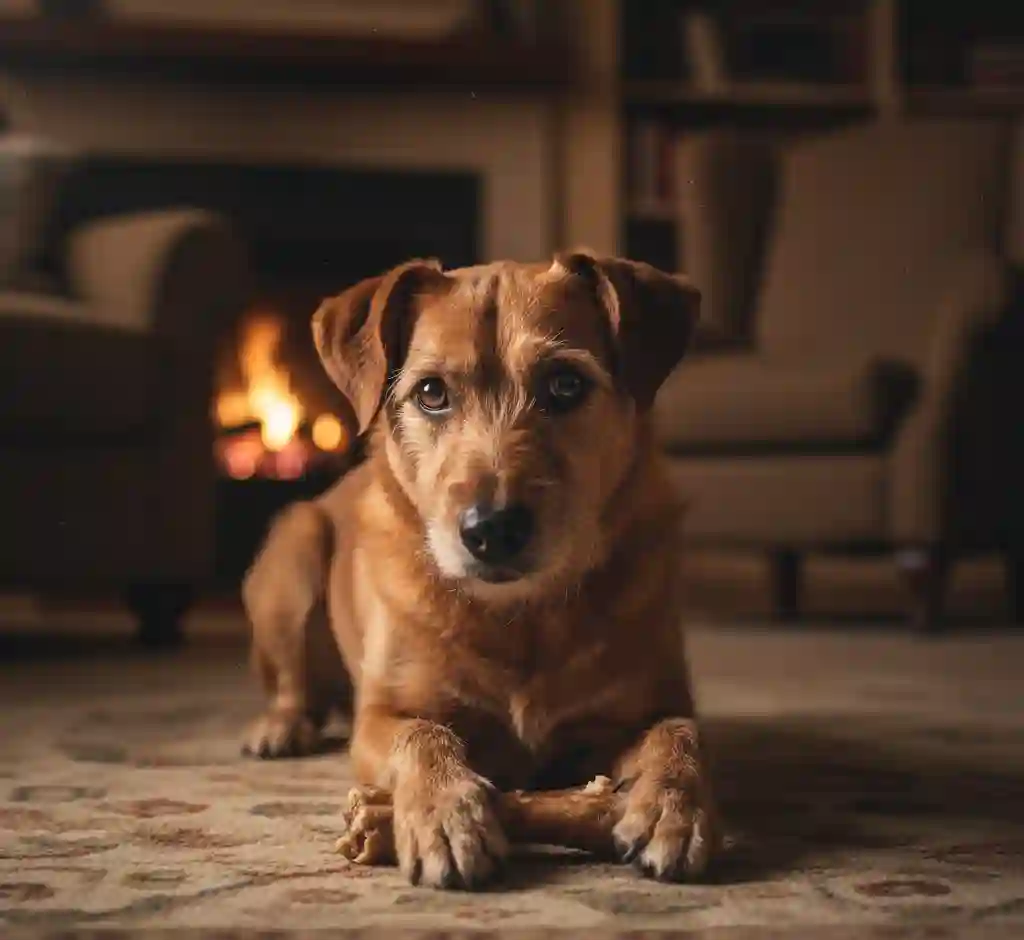
Image Specification 1 (Header)
-
Description: A close-up, low-angle shot of a dog guarding a bone. The dog has its head lowered, eyes looking up (whale eye), and body stiff. The background is blurred.
-
Filename: dog-resource-guarding-bone-warning-signs.jpg
-
ALT Text: A dog showing signs of resource guarding and food aggression, including stiffness and whale eye over a bone.
Image Specification 2 (Footer)
-
Description: A positive training scene. An owner’s hand (safe distance) tossing a piece of cheese toward a dog who is eating from a bowl. The dog looks relaxed and is looking at the cheese, not guarding the bowl.
-
Filename: positive-reinforcement-training-food-aggression.jpg
-
ALT Text: Owner using the trade-up method to treat food aggression by tossing treats near the dog’s bowl.
Manager’s Insight
Let’s have some “Real Talk.” The biggest reason owners fail at fixing food aggression is ego.
We humans have this weird obsession with needing to be able to take things away from our dogs to prove we are “in charge.” I see clients do weeks of great training, and then one day, they decide to “test” the dog by grabbing the bowl just to see if it worked.
Don’t poke the bear.
Trust is a bank account. Every time you successfully “Trade Up,” you make a deposit. Every time you grab something from their mouth, you make a massive withdrawal. Even after your dog is cured, let them eat in peace. It’s just good manners.
Scientific References
-
Jacobs, J. A., et al. (2018). Resource guarding behavior in shelter dogs and its association with aggression. Frontiers in Veterinary Science.
-
Mogi, K., et al. (2011). Beware the “jealous” dog: resource guarding in canine behavior.
-
Sherman, B. L., & Mills, D. S. (2008). Canine anxieties and phobias: an update on separation anxiety and noise aversions. (Context on fear-based aggression).