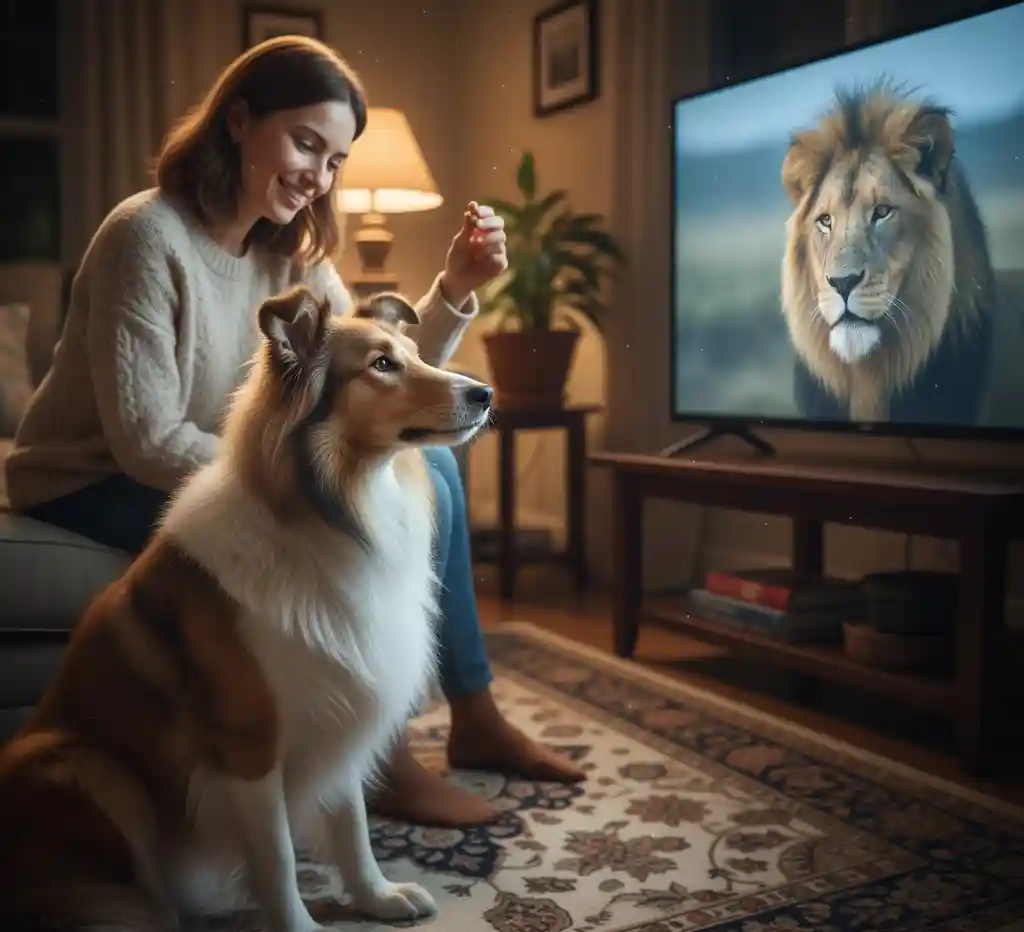
SAFETY WARNING: If your dog is lunging so forcefully that they risk knocking over the television, or if they redirect their frustration by nipping at people or other pets nearby, please stop training and consult a local professional trainer or behaviorist immediately for an in-person safety assessment.
It’s Not “Bad” Behavior: Why Your Living Room Is a Jungle
We’ve all been there. You’ve finally sat down to enjoy a nature documentary or a movie, only for your dog to explode into a barking frenzy the moment an animal appears on the screen. It’s startling, frustrating, and can make relaxing at home feel impossible.
First, I want you to know: It is not your fault, and your dog isn’t being “naughty.”
Dogs today perceive digital images much differently than they did ten years ago. Modern high-definition (4K/8K) and high-frame-rate televisions allow dogs to see fluid movement that looks incredibly real to them. Their predatory instincts or territorial drives are triggered by these “invaders” in their living room. In their mind, they are protecting their home from a high-speed intruder that never leaves.
Diagnosis: Why is Your Dog Reacting?
Understanding the why is the first step to the how. Use this table to identify your dog’s specific motivation.
| Behavior Signal | Primary Motivation | Psychological State |
| Play Bowing / Tail Wagging | Excitement & Play | The dog thinks the TV animals are potential playmates and is trying to initiate a game. |
| Low Growl / Hackles Raised | Fear / Territoriality | The dog perceives the image as a threat to their home and is trying to scare the “intruder” away. |
| Intense Staring / Whining | Predatory Drive | Common in herding or hunting breeds; the movement triggers a biological urge to “chase” and “corrall.” |
| Redirected Nipping | Frustration (Arousal) | The dog is so overstimulated by what they see that they “bubble over” and nip at the nearest object. |
The Solution: The “Look at That” (LAT) Training Method
To fix this, we use Desensitization (making the TV boring) and Counter-Conditioning (making the TV predict something wonderful).
Step 1: Establish the “Working Distance”
Start with the TV off. Sit with your dog at a distance where they are calm.
-
Action: Turn on the TV at a very low volume with a program that doesn’t usually trigger them.
-
Goal: Your dog should notice the TV but remain sitting or lying down.
Step 2: Mark the “Calm Glance”
-
Action: Wait for your dog to look at the TV. The second they look at it without barking, say a marker word like “Yes!” or use a clicker.
-
Reward: Immediately deliver a high-value treat (like a small piece of plain chicken).
-
Goal: To teach the dog that looking at the screen results in a reward from you.
Step 3: The “Look at That” (LAT) Game
Now, put on a “triggering” show (like a nature documentary) but keep the volume muted or very low.
-
The Second your dog sees an animal on screen, “Mark” (Yes!) and “Reward.”
-
If they bark: You are too close or the volume is too high. Move further back and try again.
-
Goal: You want your dog to see a bird on screen and immediately look at you for a treat instead of barking.
Step 4: Gradually Increase Intensity
-
Over several sessions, slowly increase the volume and move your dog closer to the couch.
-
Rule: If the dog has a “relapse” and barks, simply turn off the TV, wait for them to calm down, and resume at an easier level.
Frequently Asked Questions
Q: Do certain breeds bark at the TV more than others?
A: Yes. Sight hounds (like Greyhounds) and herding breeds (如 Border Collies or Shepherds) are genetically wired to be highly sensitive to movement. They are often the most “reactive” to digital screens.
Q: Why does my dog bark even when the TV is muted?
A: Dogs are incredibly observant. Even without sound, the flickering light and the specific “fluidity” of modern screens are enough to trigger their predatory drive. The movement itself is the “stimulus.”
Q: Will “Dog TV” channels help or make it worse?
A: It depends on the dog. For some, it provides enrichment. For a reactive dog, it can keep them in a constant state of high stress (cortisol spikes). If your dog barks at those channels, stop using them.
Q: Can I just tell my dog “No” when they bark?
A: Shouting “No” often makes the problem worse. Your dog thinks you are “barking along” with them at the intruder, which increases their excitement. Focus on rewarding the quiet moments instead.

Manager’s Insight: The “Yelling” Paradox
Here is the blunt truth: Owners fail at this because they lose their cool.
When your dog starts barking at the TV, your natural instinct is to shout “Quiet!” or “Shut up!”
To your dog, you are just joining the party. You’ve turned a “dog vs. TV” event into a “family vs. TV” event. Every time you yell, you are validating their fear that the thing on the screen is a big deal. The most successful trainers are the ones who stay stone-cold silent, wait for that one-second gap in the barking, and then shove a treat in the dog’s mouth. Silence is your superpower.
Scientific References
-
Hirskyj-Douglas, I., & Read, J. C. (2014). DoggyVision: Examining how dogs respond to media and the design of television for dogs.
-
Miller, P. E., & Murphy, C. J. (1995). Vision in dogs. Journal of the American Veterinary Medical Association. (Explains flicker fusion frequency in canine vision).
-
McDevitt, S. (2007). Control Unleashed: Creating a Focused and Confident Dog. (The foundational text for the “Look at That” game).